


Headless CMS Use Case: Modern Brand Sites

Amanda Jones
Most organizations don't set out to build a "brand site."
Instead, they start with a simple problem: partners need logos. Agencies need photography. Journalists need press kits. Retailers need product assets. Employees need the latest brand guidelines.
So marketing creates a page on the corporate website. Then another. Soon there's a password-protected section for partners. Then downloadable ZIP files. Eventually someone buys a dedicated brand portal because keeping everything organized has become unmanageable.
This is a familiar journey for enterprise marketing teams.
What's changing, however, is the realization that a modern brand site is no longer just a repository for digital assets. It has become an active content platform that supports partners, distributors, retailers, agencies, franchisees, media organizations, and increasingly, AI-powered experiences.
That evolution is causing many organizations to rethink the technology powering these sites.
More Than a Digital Asset Library
Traditional brand management platforms such as Lingo, Bynder, Brandfolder, Frontify, and similar products excel at one thing: organizing and distributing digital assets.
They make it easy to manage logos, photography, videos, fonts, and other creative resources while maintaining version history and approval workflows. For many marketing organizations, they're an excellent solution to the digital asset management (DAM) problem.
The challenge is that today's brand sites rarely stop at digital asset management.
Marketing teams increasingly want to publish interactive experiences, campaign landing pages, product launches, news, blogs, retailer resources, FAQs, documentation, videos, downloadable content, and partner-only information all within the same destination.
At that point, the brand portal starts looking less like a DAM system and more like a full-featured website.
That's where the architectural differences become important.
A Brand Site Is Really a Content Platform
Modern brand sites combine several capabilities that were traditionally delivered by separate products.
They need the publishing capabilities of a CMS, the organization of a DAM, the security of a partner portal, the performance of a CDN, powerful search, and APIs that allow content to be consumed by websites, mobile apps, retailers, and AI assistants.
Trying to stitch together multiple specialized products often creates unnecessary complexity.
Marketing content lives in one system. Digital assets live somewhere else. Partner authentication is handled by another platform. Search indexes everything separately.
Developers spend time integrating systems instead of building experiences.
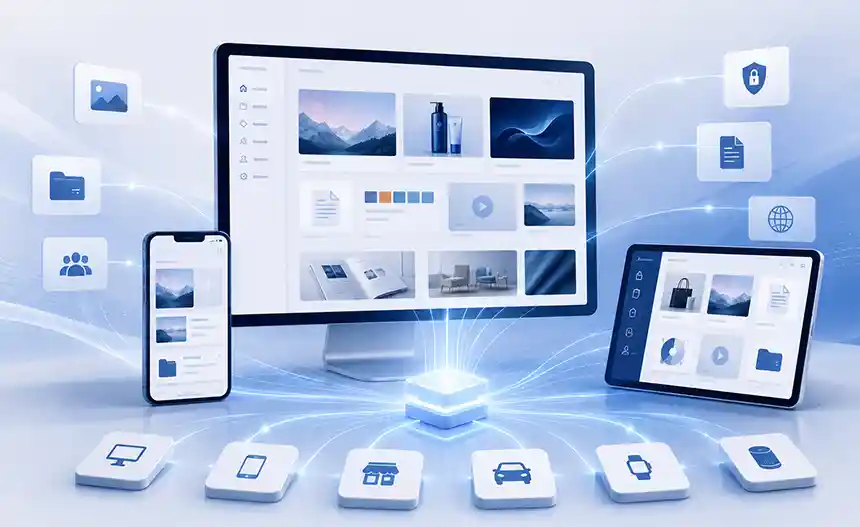
A headless CMS approaches the problem differently. Rather than treating digital assets as something adjacent to the website, it manages structured content, rich media, workflows, permissions, and APIs as part of one integrated platform.
Structured Content Changes Everything
One of the biggest differences between a traditional brand portal and a headless CMS is how information is modeled.
A DAM primarily manages file assets. A CMS manages content. That distinction becomes important as organizations grow. Imagine launching a new product.
You're not simply publishing a hero image. You're publishing product descriptions, downloadable logos, packaging artwork, lifestyle photography, videos, legal disclaimers, retailer specifications, campaign messaging, launch dates, regional variations, related products, and supporting documentation.
In a headless CMS, these become structured content types rather than disconnected files.
Because every field is structured, the same information can automatically appear across websites, partner portals, retailer experiences, mobile applications, digital kiosks, and AI-powered assistants without duplication.
The content becomes reusable instead of merely downloadable.
Security Beyond Password Protection
Most enterprise brand sites eventually require different experiences for different audiences:
- Retail partners may access promotional campaigns before launch
- Agencies may download editable design assets
- Journalists may receive embargoed press materials
- Employees may see internal branding resources that should never be public
Rather than building separate portals, a headless CMS allows organizations to secure content at a granular level while managing everything from a single platform. The result is simpler administration, fewer duplicated assets, and a more consistent publishing workflow.
Search Is an Important Interface
Think about how people actually use a brand site.
Very few browse folder hierarchies looking for "Corporate Logos > 2026 > SVG."
Instead, they typically search:
- "Latest horizontal logo."
- "Holiday campaign assets."
- "Window treatment photography."
- "Retail signage."
Search is an important navigation model, but AI will soon be the primary interface.
Conversational AI Will Be the Next Interface
Rapidly expanding in accuracy and adoption, conversational AI is beginning to replace even traditional search.
Instead of typing keywords, users will ask complete questions:
- "Which logo should I use on a dark background?"
- "Where can I find approved product photography for our fall campaign?"
- "What fonts are licensed for partner use?"
Providing accurate answers requires more than indexing filenames. It requires structured content with rich metadata, relationships, permissions, and APIs.
This is precisely where headless CMS platforms excel.
Why Git Matters
One capability that rarely appears on brand portal comparison charts is version control.
Most enterprises already rely on Git to manage software development. CrafterCMS extends that same proven model to content.
Every page, asset reference, template, and configuration change is versioned automatically. Marketing teams gain a complete history of every change.
Editors can compare revisions, roll back mistakes, review approvals, and audit publishing activity without introducing another proprietary repository. For organizations with multiple brands, regional teams, and agency partners, this level of governance becomes increasingly valuable.
Why Organizations Consolidate
Many enterprises don't replace their brand portal because it failed.
They replace it because they realize they're maintaining multiple systems that solve pieces of the same problem.
- A dedicated DAM
- A CMS
- A partner portal
- A search platform
- Custom integrations
Eventually someone asks a simple question: "Why are we maintaining four products to build one brand experience?"
A modern headless CMS provides an opportunity to consolidate those capabilities into a single content platform while still integrating with specialized tools where appropriate.
For organizations that already have a significant investment in a DAM such as Bynder or Brandfolder, a headless CMS doesn't necessarily replace it. Instead, it can complement it by serving as the publishing platform that delivers structured content and experiences while continuing to consume approved assets from the DAM.
The goal isn't replacing every existing system. It's creating a central content platform that orchestrates them.
Why CrafterCMS
CrafterCMS was designed for organizations building large-scale digital experiences rather than simple websites.
Its API-first architecture, embedded Git repository, enterprise workflows, role-based security, high-performance content delivery, SOC 2 compliance and flexible deployment model make it well suited for modern brand sites and partner portals.
Unlike platforms that focus primarily on digital asset management, CrafterCMS manages the entire experience that ranges from structured content and page authoring to secure partner access, search, APIs, and AI-ready content delivery.
As organizations increasingly view their brand site as a strategic digital experience rather than simply an asset library, this integrated approach becomes a significant architectural advantage.
Final Thoughts
The definition of a brand site has changed. It is no longer a collection of downloadable logos and PDFs.
It has become a content hub where marketing, partners, retailers, agencies, journalists, employees, and AI systems all interact with the same information.
Dedicated brand management platforms remain excellent solutions for managing creative assets. But when organizations need to publish rich digital experiences, secure partner portals, omnichannel APIs, conversational AI, and enterprise workflows, a headless CMS provides a broader foundation for growth.
The future of brand sites isn't simply better asset management. It's treating your brand as content that can be securely managed, intelligently searched, and delivered anywhere your audience (or their AI assistant) needs it.
Learn More
Try CrafterCMS free today and start building a modern brand portal for your partners.
Related Posts
MCP and CMS: Connecting AI Agents to Enterprise Content

Amanda Lee
Why Search Is a First-Class CMS Capability
Amanda Jones
Magnolia DXP vs CrafterCMS: Comparing Enterprise CMS Platforms
Amanda Lee
Adobe AEM vs CrafterCMS: Which Enterprise CMS Is Better?

Sara Williams
Related Resources
-
CrafterCMS at eBay: The Universal Content Platform for eBay.com
Webcast
-
Personalized Digital Experiences for a Cruise Liner
Webcast
-
Introducing CrafterCMS v4.0
Webcast
-
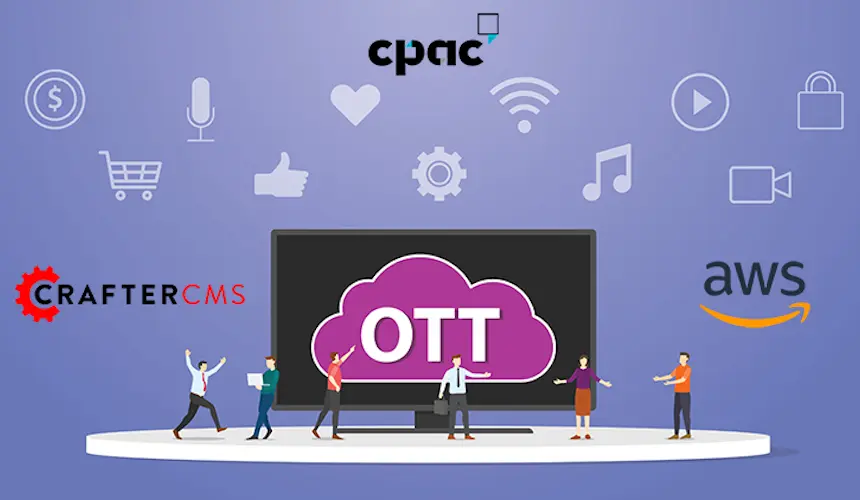
Modernizing Video Delivery and Content Management at CPAC, A Canadian Nationwide Broadcaster
Webcast
-
Building React Apps on a Headless CMS
White Paper