




Is Your CMS Ready for AI Agents?

Amanda Jones

Since they were invented, content management systems have operated around two basic assumptions.
Humans create content. Humans consume content.
Authors, marketers, developers, and other employees create and manage content in the CMS. Website visitors, customers, employees, and other people consume that content through websites, mobile applications, portals, and other digital experiences. Virtually every CMS architecture has been designed around this model.
AI agents are beginning to break both assumptions.
On the authoring side, AI agents are emerging as a new type of CMS user. They can search repositories, understand content models, generate and modify content, perform migrations, localize pages, validate information, and participate in publishing processes.
On the delivery side, AI agents are becoming content consumers. ChatGPT, AI search engines, shopping agents, enterprise assistants, conversational interfaces, and autonomous browsers increasingly need to discover, understand, and act on enterprise content.
The result is a fundamental change in how we should think about content management. The next generation of CMS, an agentic CMS, needs to serve four participants: human authors, AI authors, human visitors, and AI visitors.
That has significant implications for CMS architecture.
From Two CMS Participants to Four
The traditional CMS model is relatively straightforward.
A human author creates content. The CMS stores and manages it. A human visitor eventually consumes that content through a website or another digital channel.
Headless CMS platforms expanded the delivery side of this model by separating content from presentation. Instead of assuming every piece of content would become an HTML page, content could be delivered through APIs to websites, mobile apps, kiosks, digital signage, voice applications, and other experiences.
AI introduces another architectural shift.
There are now potentially two kinds of authors:
- Human authors
- AI agents acting as authors
And two kinds of consumers:
- Human visitors
- AI agents acting as consumers
The important point is that AI is not simply another feature inside the CMS user interface. Instead, it's becoming another participant in the content ecosystem.
AI Agents as CMS Authors
Much of the first generation of CMS AI functionality focused on helping marketers write faster.
Generate a headline. Rewrite a paragraph. Suggest SEO keywords. Create a summary. Translate an article.
These capabilities are useful, but they are essentially AI-powered buttons embedded in an existing authoring workflow.
Agents can go considerably further.
Imagine giving an AI agent controlled access to a content repository and the tools required to work with it. The agent could be asked:
"Find every product page using the old product specification model, migrate the content to the new schema, identify records that cannot be migrated automatically, and prepare the changes for review."
Or:
"Find articles that reference products we no longer sell, update references where a replacement product exists, and flag everything else for an editor."
Or:
"Create localized versions of these 200 pages for our new market while preserving product names and terminology from our approved glossary."
These aren't individual content-generation prompts. They are jobs.
To perform them, an agent needs to understand the content structure, inspect existing content, reason about what needs to change, invoke tools, make modifications, validate its work, and potentially interact with workflows.
In other words, it needs to behave much more like a CMS user.
That does not mean handing an AI model unrestricted control over an enterprise content repository. The same principles applied to human users should apply even more rigorously to agents: permissions, defined capabilities, auditability, versioning, approval workflows, and human oversight.
For example, with CrafterCMS any AI authoring agent is coupled to the CMS user it is helping and is always under control of the user, with the same (limited) privileges that the user has based on their assigned user role.
An agent might be allowed to create and modify content but not publish it. Another might only analyze content. A specialized migration agent might be given broader permissions for a limited project.
The CMS becomes the governance layer around both human and (human-managed) machine content operations.
AI Agents as Content Consumers
The change on the delivery side may ultimately be even larger.
People have traditionally discovered enterprise content through interfaces created for people: websites, navigation menus, search boxes, landing pages, product catalogs, and mobile applications.
AI increasingly sits between the organization and the person.
Someone may ask ChatGPT a question about a product rather than visiting the manufacturer's website. A customer might ask a shopping assistant to find a product meeting specific requirements. An employee might ask an enterprise agent about company policy instead of navigating an intranet. A procurement agent could potentially research products, compare specifications, and interact with supplier systems on behalf of a buyer.
The content consumer in each of these cases is initially software. And software doesn't need a hero image, hamburger menu, carousel, or beautifully rendered product page. It needs content and context. That makes structured content increasingly important.
A product represented as structured fields for name, description, specifications, compatibility, pricing, availability, documentation, and relationships is inherently easier for machines to understand and use than information buried inside presentation-oriented HTML.
This doesn't make websites obsolete. Humans will continue to want rich digital experiences.
It means enterprises increasingly need to serve both.
Headless CMS Was Preparing Us for This
Interestingly, many of the architectural principles required for the agentic web already exist.
Headless CMS architecture separated content from presentation because organizations needed to deliver content to more than one channel.
The same separation becomes even more valuable when one of those channels is an AI agent. Structured content is not tied to a particular page. APIs make content accessible outside the website. Content models provide semantic meaning. Relationships between content objects provide additional context.
These characteristics allow the same underlying content to support a web page designed for a human and an AI experience designed for a machine.
In that sense, AI is reinforcing one of the central ideas behind headless CMS: content should be treated as reusable data rather than simply as pages.
But APIs alone aren't the entire answer. Agents also need ways to discover capabilities and take actions.
From APIs to MCP
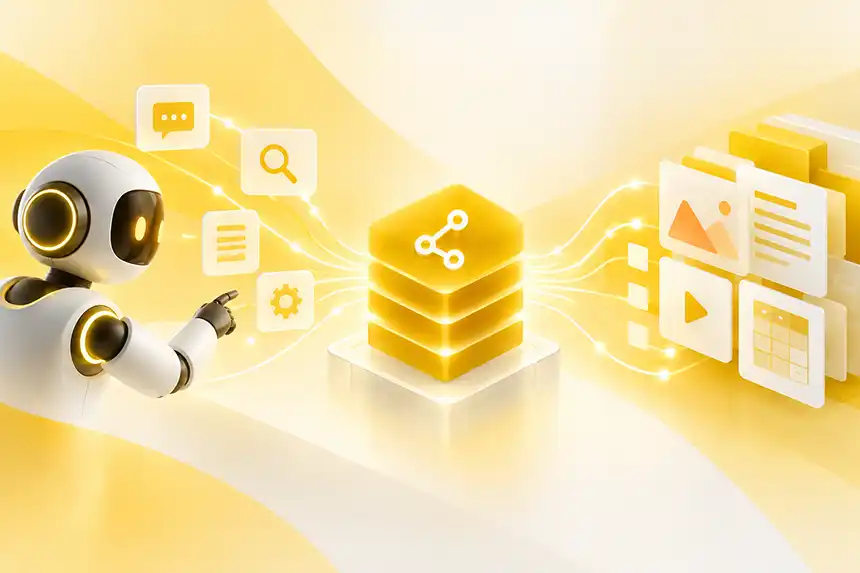
APIs made it possible for applications to communicate with content platforms. The Model Context Protocol (MCP) is helping extend that model to AI agents.
MCP provides a standardized way for agents and AI applications to discover and use tools, resources, and capabilities exposed by other systems.
For a CMS, that creates interesting possibilities. Instead of building a custom integration for every AI application, a CMS can expose controlled capabilities that agents can understand and invoke.
An authorized agent might search content, retrieve an item, inspect a content model, create content, update fields, initiate a workflow, or perform other approved operations.
This is an important distinction. The CMS is no longer merely providing content to AI. It can provide tools for AI to work with content.
That is where the transition from AI-enabled CMS to truly agentic content management begins.
Architecture Matters More Than an AI Button
This is also why evaluating a CMS based on whether it has an "AI assistant" checkbox misses the larger issue.
Generative AI features can be added to almost any CMS interface.
The harder question is whether the underlying platform was designed in a way that allows AI to become a first-class participant.
- Can content be represented structurally?
- Can it be accessed programmatically?
- Can agents work with content independently of the authoring interface?
- Can permissions constrain what an agent is allowed to do?
- Can changes be versioned, reviewed, audited, and rolled back?
- Can AI retrieve relevant enterprise knowledge efficiently?
- Can the CMS expose tools and capabilities to external agents?
These are architectural questions, not chatbot features.
CrafterCMS and the Four-Participant CMS
This architectural transition aligns naturally with how CrafterCMS has been built.
CrafterCMS manages structured content independently from presentation and exposes that content through APIs for delivery across digital channels. Its Git-based content repository provides native versioning and a strong foundation for tracking changes made by humans or AI.
On the AI side, CrafterCMS combines its Java and Spring foundation with Spring AI, allowing developers to integrate large language models and build AI-powered applications and agents using the broader Spring ecosystem.
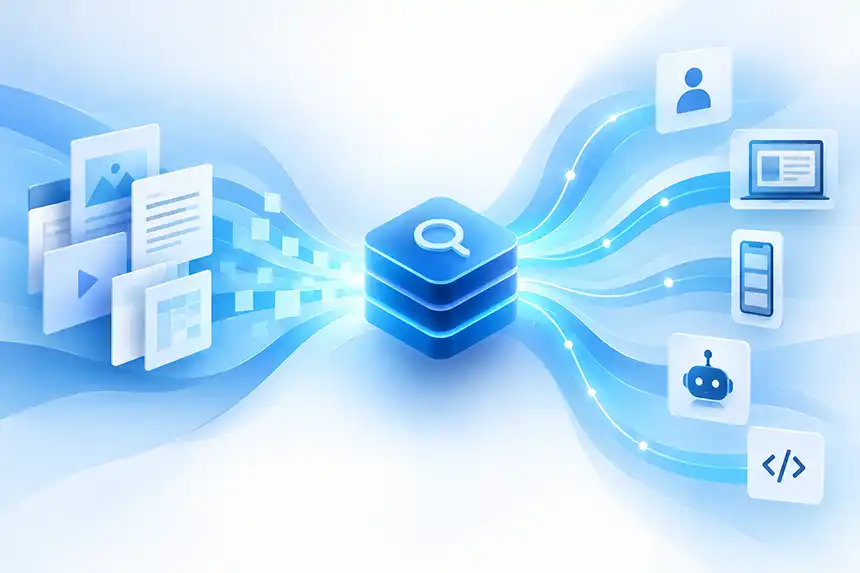
OpenSearch adds semantic and vector search capabilities that can support retrieval-augmented generation and intelligent content discovery. AI experiences can retrieve relevant information from published content rather than relying solely on what a model already knows.
MCP extends the architecture further by enabling AI agents to interact with CMS tools and capabilities in standardized ways.
Together, these aren't simply features for adding an AI writing assistant to a CMS. They are building blocks for an architecture in which humans and AI can both work with enterprise content.
The CMS Is Becoming Infrastructure for Humans and Machines
We are still early in the transition to agentic computing.
Nobody knows exactly how quickly autonomous shopping agents, AI browsers, enterprise agents, and other emerging interfaces will change the way people interact with digital content. But the architectural direction is becoming clearer.
Organizations will continue to need outstanding digital experiences for people. At the same time, they increasingly need their content to be understandable, retrievable, and actionable by machines. And their content operations will increasingly involve collaboration between human teams and AI agents.
That creates a different requirement for the CMS. The CMS of the past connected human authors with human audiences.
The CMS of the agentic era needs to support human authors, AI authors, human visitors, and AI visitors, all while maintaining the governance, security, workflow, and control enterprises require.
The question for enterprise architects is therefore becoming much bigger than, "Does our CMS have AI features?"
The better question is: Is our CMS architecture ready for AI agents?
Try CrafterCMS Now
Ready to experience an Agentic CMS and accelerate your content operations? Register for a free CrafterCMS trial today.
Related Posts

Meet the Crafter Studio AI Assistant: AI-Powered Content Authoring
Amanda Jones
MCP and CMS: Connecting AI Agents to Enterprise Content

Amanda Lee
Why Search Is a First-Class CMS Capability
Amanda Jones

Magnolia DXP vs CrafterCMS: Comparing Enterprise CMS Platforms
Amanda Lee