



How to Replace Your CMS with AI

Amanda Lee

“Traditional CMS platforms are dead. AI will replace them.”
It’s a catchy headline. It sounds bold. It feels inevitable.
But can do we do it for real? And how?
AI is replacing the old experience layer around content. Static websites, hard-to-use authoring tools, legacy portals, outdated intranets, and endless click-through admin screens are all vulnerable to a better model built around natural language, automation, and intelligent assistance.
So if your goal is to “replace your CMS with AI,” the smartest path is to start with the right foundation, and then layer your AI-powered authoring and site visitor experiences on top.
Let's dive in.
AI Still Relies on Content
Large language models are impressive, but they do not magically create trusted enterprise knowledge.
They need:
- Structured content
- Accurate source material
- Searchable repositories
- Approval workflows
- Security controls
- APIs and integrations
- Real-time retrieval
Without those things, AI becomes unreliable fast. That means the organizations that win with AI will not be the ones that just delete their CMS. They’ll be the ones that replace it with an AI-ready content platform.
What “Replacing Your CMS with AI” Actually Means
The old stack looked like this: User → Website → CMS
The new stack looks like this: User → AI Agent / Conversational Interface → Content APIs + Enterprise Systems
AI becomes the new interface. Your content platform becomes the engine behind it. So the real question becomes: What kind of AI content platform should power your AI future?
Start with an Open Platform Built for AI
To thrive in the AI era, you need more than a legacy CMS with a chatbot bolted on. You need an open platform designed for flexibility, scale, and machine-readable content. That means starting with a system that offers:
Decoupled Authoring and Delivery
Authoring tools and delivery infrastructure should be independent.
This lets you innovate rapidly on customer experiences, APIs, apps, and AI interfaces without disrupting editorial workflows. It also enables modern architectures where content can power websites, e-commerce, mobile apps, kiosks, chatbots, and agents simultaneously.
Git for Content
Content stored in Git unlocks a massive advantage:
- Version control
- Branching workflows
- Rollbacks
- Audit trails
- CI/CD pipelines
- Content as AI-friendly structured text files (not proprietary database tables)
When content lives like code, AI tools can understand it, transform it, and automate around it.
OpenSearch for Search + Vector AI
Traditional site search is no longer enough.
Modern organizations need one engine that can power:
- Keyword search
- Faceted discovery
- Content indexing
- Semantic retrieval
- Vector embeddings
- RAG applications
- AI agents grounded in enterprise knowledge
That unified model is powerful, efficient, and future-ready.
Extensible Authoring Applications
Legacy authoring tools are rigid.
Modern authoring experiences should be API-first and extensible so you can embed:
- AI copilots
- Prompt workflows
- Prompt version control
- SEO/GEO assistants
- Translation tools
- Metadata generators
- Compliance validators
- Personalized content recommendations
Your authors should work with AI inside the CMS, not outside of it.
Deterministic + Probabilistic: The Winning Stack
This is where many companies get confused. AI is probabilistic. It generates likely answers.
Enterprises still need deterministic systems that guarantee truth, control, and process.
Examples:
- Product pricing
- Healthcare policies
- Legal disclaimers
- Approved marketing copy
- Regulatory content
The future is not AI instead of systems. It is: deterministic systems + probabilistic interfaces
Your CMS manages truth. AI makes truth easier to use. That's the winning combination.
DevContentOps for AI
The AI era also changes how teams work. Developers, content teams, marketers, and AI systems must collaborate on the same operating model.
That means:
- Git-based workflows
- Content pipelines
- Reusable structured models
- Automated publishing
- AI-assisted updates
- Cross-functional iteration
- Authors collaborating with AI for content
- Developers collaborating with AI for site and feature development
This is DevContentOps for AI, where content operations become as agile as software delivery. Organizations still trapped in legacy CMS silos will struggle to keep pace.
AI Skills, MCP, and Agentic Workflows
The next generation of platforms will expose content systems directly to AI tools.
That includes:
- AI Skills for productivity inside authoring and CMS developer tools
- MCP (Model Context Protocol) for interoperability with external AI systems
- Agent workflows that can retrieve, update, validate, and publish content
- Prompt-driven administration and automation
This is where content management stops being menus and forms and traditional UI, and starts becoming conversational operations.
So… How Do You Replace Your CMS with AI?
You replace your old CMS experience with AI while upgrading to a new AI-enabled headless content platform built to support it.
That means:
- Keep a governed source of truth
- Modernize content architecture
- Add AI-powered authoring
- Add AI-powered delivery experiences
- Expose systems to agents and automation
- Move faster with open architecture
Why CrafterCMS Is the Right Foundation
CrafterCMS combines the capabilities modern organizations need:
- Decoupled authoring and delivery
- Git-based content management
- Embedded OpenSearch
- API-first architecture
- Extensible authoring tools with AI built-in for content teams
- High-performance delivery with integrated AI skills and AI coding tools
- AI integrations and MCP readiness
- Enterprise-grade scalability, security and control
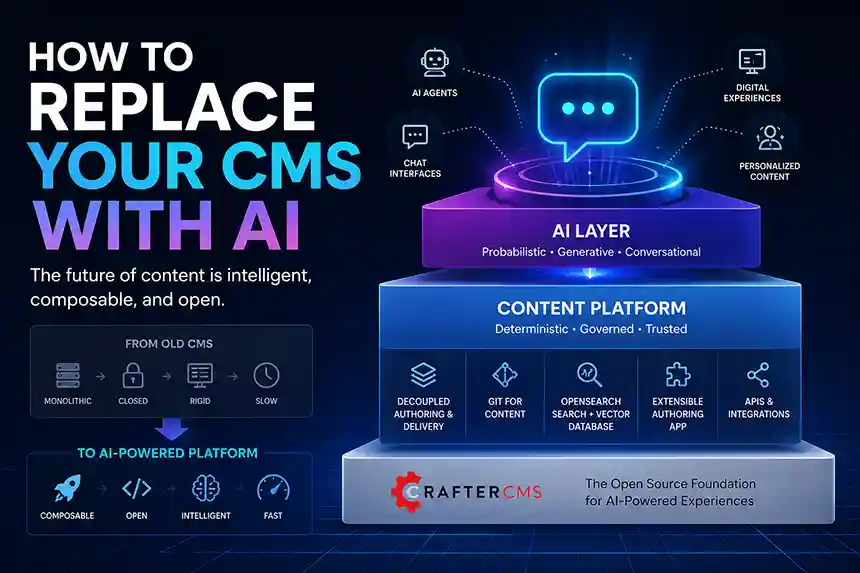
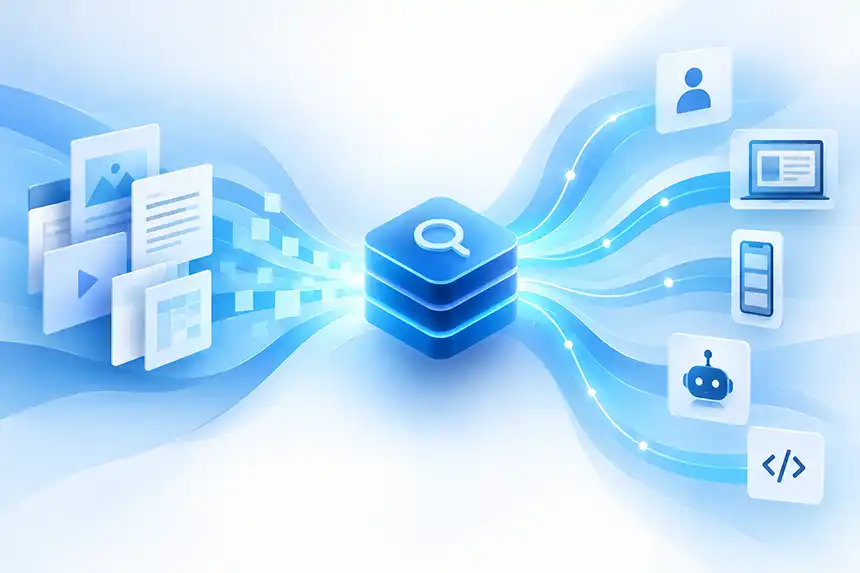
As shown above: Start with CrafterCMS as your foundation. Then build your AI CMS authoring experience and AI-driven digital experiences on top.
That’s how you actually replace your CMS with AI.
Next Steps
Get started on your AI CMS journey today by downloading the open source CrafterCMS platform now.
Related Posts

What Is WebMCP? Making Websites Ready for AI Agents

Sara Williams

Meet the Crafter Studio AI Assistant: AI-Powered Content Authoring

Amanda Jones
MCP and CMS: Connecting AI Agents to Enterprise Content
Amanda Lee
Why Search Is a First-Class CMS Capability
Amanda Jones