




Why Search Is a First-Class CMS Capability

Amanda Jones
Search has traditionally been treated as a secondary feature of a content management system. Organizations selected a CMS to create pages, manage content, establish publishing workflows, and operate websites. Somewhere toward the end of the implementation, someone would ask: What are we doing about search?
A search box was added to the header. Pages were indexed. A results template was created.
Done.
That approach made sense when the primary job of a CMS was publishing websites and the primary job of search was helping visitors find pages. Neither assumption holds anymore.
Modern search infrastructure powers content discovery, faceted navigation, recommendations, personalization, semantic retrieval, Retrieval-Augmented Generation (RAG), and increasingly, AI agents.
And with the emergence of the Model Context Protocol (MCP), search can also become an interface between CMS-managed knowledge and an expanding ecosystem of AI-enabled applications.
Search has evolved from a website feature into a fundamental part of the content architecture. And that means organizations should start treating search as a first-class CMS capability.
Search Is Really Content Retrieval
The word "search" can undersell what modern search platforms actually do.
Consider a product catalog managed within a CMS. A visitor might want to find products matching a combination of requirements:
- Product category
- Application
- Technical specifications
- Geography
- Compatibility
- Price range
- Certification
- Availability
A traditional website search box represents only one way of accessing this information.
The website itself might need to dynamically retrieve products matching particular attributes. A mobile application might need the same information. A personalization engine might need to identify related content. An AI assistant might need to find the five most relevant documents for answering a customer's question.
All of these are forms of content retrieval.
A modern CMS architecture therefore needs more than the ability to store and publish content. It needs an efficient mechanism for finding the right content based on increasingly sophisticated criteria.
A CMS Repository and Search Engine Have Different Jobs
This distinction is important architecturally. The CMS repository is the authoritative source for managed content. It needs to support capabilities such as structured content models, editing, versioning, workflow, permissions, governance, and publishing.
A search engine solves a different problem. It is optimized for indexing information and retrieving it quickly using queries, filters, rankings, aggregations, and other retrieval techniques. Trying to make the CMS repository itself satisfy every runtime retrieval requirement creates unnecessary coupling.
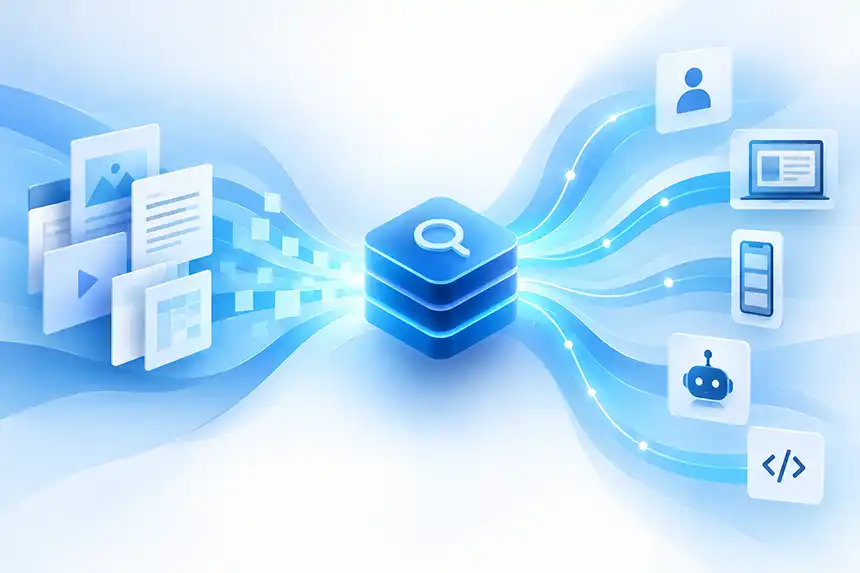
A better model is: CMS -> Publish -> Search Index + Content APIs -> Digital Experience
Content is created and governed in the CMS. When published, the appropriate content and metadata are indexed into specialized search infrastructure and available through a search API, in addition to being exposed via content APIs.
Applications can then query the search index without placing those workloads on the authoring repository. This separation becomes especially valuable as the number of channels and applications consuming CMS content grows. CMS and search can work naturally together to enable modern content and AI experience development.
Headless CMS Makes Search Even More Important
Headless CMS architecture changed the relationship between content and presentation. Instead of assuming that content ultimately becomes a web page, headless CMS platforms expose structured content through APIs. Developers decide how that content is assembled into experiences.
That means retrieval becomes much more dynamic.
An application might need to retrieve: "The five newest cybersecurity articles targeted at financial services executives."
Another might request: "Products compatible with outdoor installations below -20°C."
Another might need: "Related documentation for this product, ranked by relevance."
These aren't simply page requests. They are queries against structured content. A capable search layer can execute those queries efficiently while giving developers the flexibility to create entirely new experiences from the same underlying CMS-managed content.
This is one reason search should be considered part of the CMS architecture rather than an add-on to the website.
Structured Content Makes Search Better
There is another important connection between CMS and search: the quality of the content model directly affects the quality of retrieval.
Suppose an organization stores product information primarily as large blocks of rich text. A search engine can index that text, but it has relatively little explicit information about what the content means.
Now consider the same product represented using structured fields:
- Product Name
- Product Family
- Industry
- Operating Temperature
- Certifications
- Applications
- Region
- Technical Specifications
Suddenly, search becomes dramatically more powerful. Applications can filter, facet, sort, aggregate, and combine these attributes in sophisticated ways.
The CMS provides the semantic structure. The search platform makes that structure retrievable.
This is why good content modeling is not simply an authoring concern. It directly affects the capabilities developers can provide to users downstream.
Search Has Moved Beyond Keywords
Traditional search primarily answered a question: Which documents contain these words? Modern search increasingly tries to answer a more difficult question: Which content best matches what this person means?
That's the foundation of semantic search.
Vector embeddings allow content to be represented mathematically according to semantic relationships. A user's query can also be represented as a vector, making it possible to retrieve content that is conceptually similar even when it doesn't contain exactly the same terminology.
For example, someone might search: "How do employees log in using our company credentials?" The relevant documentation might be titled: "Configuring SAML-Based Single Sign-On."
Traditional keyword matching may have difficulty connecting the two. Semantic search can recognize their conceptual relationship.
Modern search platforms such as OpenSearch can support vector search alongside traditional full-text search, allowing CMS-powered applications to offer much more intelligent content discovery.
Hybrid Search Gives You Both
Semantic search doesn't eliminate the value of keywords. Sometimes exact matching is precisely what users need.
Product numbers, model names, error codes, technical terminology, regulations, people's names, and other specific identifiers often benefit from traditional lexical search.
That's why hybrid search is particularly interesting for CMS applications. Hybrid retrieval can combine traditional keyword relevance with semantic similarity.
The search system can effectively consider both:
- What words did the user enter?
- What does the user appear to mean?
That combination can dramatically improve content discovery, particularly across large documentation libraries, product catalogs, knowledge bases, support sites, and other content-rich digital experiences.
But search is about to become even more important for another reason.
Generative AI Depends on Retrieval
Generative AI has changed the role of search in content architecture.
Large language models are extraordinarily good at understanding and generating language. But enterprise applications generally need answers based on current, authoritative organizational information.
That information often resides in the CMS. Retrieval-Augmented Generation addresses this by retrieving relevant information and supplying it to the language model as context. Search is the foundation here.
Without good retrieval, even an excellent language model may receive the wrong information, incomplete information, or no useful information at all. The quality of an AI experience therefore depends heavily on the quality of the retrieval architecture behind it.
For organizations already managing authoritative digital content within a CMS, the connection is natural: The CMS governs the knowledge. The search layer retrieves it. The LLM interprets and communicates it.
AI Agents Make Search Even More Strategic
AI agents push this architecture further.
An AI agent doesn't simply generate text. It can reason about a user's request, retrieve information, use tools, invoke APIs, and potentially take actions.
Before an agent can act intelligently, however, it frequently needs to understand the organization's content.
Imagine a customer asking: "Which of your products meets these requirements, and can you show me the installation instructions?"
An agent may need to search products, evaluate structured specifications, retrieve relevant documentation, and formulate an answer before determining what action should happen next.
Search becomes part of the agent's knowledge infrastructure. And this points toward a broader transition in CMS architecture. Historically, CMS content was primarily created by humans and consumed by humans. Increasingly, CMS content will also be consumed by software agents.
Those agents don't necessarily need another beautifully rendered web page. They need structured, queryable, authoritative information.
Search becomes one of the mechanisms that makes that possible.
MCP Gives AI Agents an Interface to CMS Knowledge
This brings us to another important development: the Model Context Protocol (MCP).
MCP provides a standardized way for AI applications and agents to interact with external systems and capabilities. Instead of building a proprietary integration for every AI assistant, agent, or development environment, an organization can expose appropriate capabilities through an MCP server.
For a modern CMS, that has significant implications.
Imagine exposing CMS capabilities such as:
- Search content
- Retrieve an individual content item
- Find related content
- Inspect a content model
- Retrieve product information
- Search documentation
An AI application can discover and invoke those capabilities through MCP. But MCP itself does not magically make enterprise content easy to find. It provides the interface.
Something still needs to perform the retrieval. That is where powerful search infrastructure becomes particularly important.
Consider an AI agent asking a CMS through MCP:
"Find documentation explaining how our European customers configure SSO."
The MCP server can expose a content search capability, while the CMS's underlying search infrastructure performs the actual retrieval using keyword search, metadata filtering, semantic search, vector similarity, or some combination of them.
MCP therefore doesn't replace search. It makes good search more valuable by giving AI systems a standardized mechanism for accessing it.
From Human APIs to Agent Interfaces
There is a useful parallel with the evolution of headless CMS. Headless CMS emerged partly because organizations needed content to be available to more than one presentation layer.
Instead of coupling content directly to HTML pages, the CMS exposed APIs that could be consumed by websites, mobile apps, kiosks, commerce applications, and other digital channels.
MCP represents a similar architectural evolution for AI. REST and GraphQL APIs are primarily designed for developers building applications. MCP makes tools, resources, and contextual information directly discoverable and usable by AI applications and agents.
That means a modern CMS may ultimately expose content through several complementary interfaces:
- Web experiences for humans
- Content APIs for applications
- Search interfaces for retrieval
- MCP interfaces for AI agents
The underlying content remains governed by the CMS. What changes is the number and type of consumers.
Search Makes MCP Far More Powerful
This is where the combination becomes particularly compelling.
An MCP server backed only by simple content lookup can expose content to an agent. But an MCP server backed by sophisticated search infrastructure can expose something much more useful: the ability to intelligently explore an organization's knowledge.
An AI agent might request: "Find products suitable for outdoor installations in subzero temperatures."
The search layer could combine structured metadata filters with semantic similarity.
Another AI agent might ask: "Find everything related to our SAML configuration and rank the most relevant documentation."
Hybrid search could combine exact terminology with semantic retrieval.
Or an AI development assistant could ask: "Find examples in the CMS showing how this component is configured."
The same search infrastructure can retrieve relevant structured content for the agent.
In other words, MCP provides the doorway into the content platform. Search determines how intelligently the agent can navigate what is behind that doorway. This is another reason organizations should stop thinking about CMS search merely as website functionality.
Search increasingly becomes infrastructure for machine-to-content interaction.
Search as a Core Capability in CrafterCMS
CrafterCMS treats search as part of the delivery architecture rather than simply a widget added to a website.
CrafterCMS embeds OpenSearch to provide powerful search capabilities across published content. Content can be indexed as part of the publishing and deployment process and queried by applications running on the delivery tier. This complements CrafterCMS's headless and composable architecture.
Developers can use structured CMS content to build traditional search experiences, dynamic content queries, faceted navigation, recommendations, and other retrieval-driven applications. OpenSearch also creates a foundation for newer use cases involving semantic retrieval, vector search, RAG, and AI.
CrafterCMS's emerging AI architecture extends this model further with MCP support, enabling AI-enabled applications and agents to interact with CMS capabilities through a standardized interface.
Together, the technologies serve complementary roles:
- CrafterCMS manages and governs the content
- OpenSearch makes the content intelligently retrievable
- MCP makes CMS capabilities accessible to AI applications and agents
That becomes increasingly important as organizations move from simply publishing content to making that content available as trusted knowledge for intelligent systems.
The CMS of the Future Is Also a Knowledge Platform
The definition of a CMS is expanding. Creating, editing, governing, and publishing content remain essential capabilities. But organizations increasingly need to make that content useful across websites, applications, search engines, AI assistants, and autonomous agents. That requires thinking differently about retrieval.
Search shouldn't be the feature added during the final phase of a website implementation. It should influence content modeling. It should influence delivery architecture. It should influence APIs. It should influence how organizations prepare their content for AI.
And increasingly, it should influence how CMS platforms expose that knowledge to AI systems through interfaces such as MCP.
The emerging architecture is powerful:
- CMS: governed, structured knowledge
- OpenSearch: intelligent retrieval
- MCP: standardized AI access
- LLMs and agents: reasoning, interaction, and action
This is a significant change from the traditional CMS model.
The future of content management isn't simply about storing and publishing information. It is about making trusted information discoverable, retrievable, and usable by humans, applications, and AI agents.
That's why search is no longer an optional CMS feature. It is a first-class capability of the modern content platform.
Learn More
Register for a free CrafterCMS trial today and see how a built-in, powerful search engine transforms the building and management of content-rich digital experiences.
Related Posts

What Is WebMCP? Making Websites Ready for AI Agents

Sara Williams

Meet the Crafter Studio AI Assistant: AI-Powered Content Authoring
Amanda Jones

MCP and CMS: Connecting AI Agents to Enterprise Content

Amanda Lee

Magnolia DXP vs CrafterCMS: Comparing Enterprise CMS Platforms
Amanda Lee