



MCP and CMS: Connecting AI Agents to Enterprise Content

Amanda Lee
Content management systems have traditionally been designed around a relatively straightforward model: people create content, the CMS manages and publishes it, and websites or applications present that content to other people.
Headless CMS expanded that model. Content APIs made CMS-managed information available to websites, mobile applications, e-commerce systems, digital signage, and virtually any other application developers wanted to build. Content became independent of its presentation and could be reused across many different digital experiences.
Now another major consumer of enterprise content is emerging: AI agents.
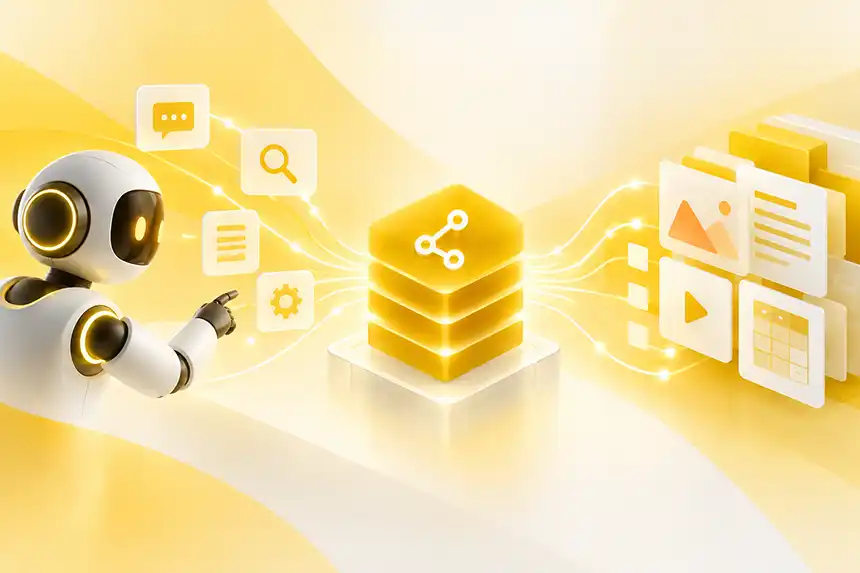
AI assistants, agents, and AI-enabled applications need access to trusted enterprise information. They need to search content, retrieve structured data, understand products and documentation, interact with services, and sometimes take actions on behalf of users. The CMS can provide much of the authoritative content these systems need, but connecting AI systems to enterprise content introduces a new set of architectural requirements.
That's where the Model Context Protocol (MCP) becomes important.
MCP provides a standardized way for AI applications and agents to interact with external tools, resources, and services. For CMS platforms, it creates an important new interface between governed enterprise content and the rapidly growing ecosystem of AI-enabled applications.
In much the same way that content APIs helped make CMS content accessible to applications, MCP can help make content and CMS capabilities accessible to AI.
What Is MCP?
The Model Context Protocol is an open protocol designed to standardize how AI applications connect to external systems.
Without a common protocol, developers building AI applications face a familiar integration problem. An agent may need access to a CMS, CRM, product catalog, document repository, search engine, analytics platform, ticketing system, or any number of other enterprise applications. Traditionally, each of those connections requires application-specific integration code and knowledge of the particular system's APIs.
MCP introduces a common interaction model. An MCP server can expose resources, tools, and capabilities, while an MCP client can discover and invoke those capabilities on behalf of an AI-enabled application.
This is particularly interesting for content management because enterprise CMS platforms contain something AI systems desperately need: trusted, current, governed information.
Why CMS Content Matters to AI Agents
Large language models provide remarkable reasoning and language capabilities, but enterprise AI cannot depend entirely on knowledge encoded into an LLM during training.
Enterprise information changes constantly. Products change. Policies change. Documentation changes. Prices change. Marketing messages change. Regulations change. New content is created every day.
Organizations therefore need AI systems grounded in authoritative information, and much of that information is already managed by the CMS.
A modern enterprise CMS may contain product information, documentation, marketing content, policies, FAQs, location information, technical specifications, articles, customer resources, and many other forms of structured and unstructured content. Just as importantly, the CMS provides governance around that information. Content can be modeled, reviewed, versioned, approved, published, and audited.
That makes the CMS a natural knowledge foundation for enterprise AI agents.
The challenge is no longer simply publishing that information to a website. Organizations need mechanisms that allow AI applications and agents to find and use it intelligently. MCP provides an increasingly important standardized interface for doing exactly that.
From Content APIs to Agent Interfaces
Headless CMS changed content architecture by separating content from presentation. Instead of assuming CMS content would always become an HTML page, headless platforms exposed APIs that developers could use to retrieve structured content.
That enabled one CMS to serve websites, mobile applications, commerce experiences, portals, kiosks, and other digital channels. Developers knew the API contract, wrote software against it, and determined how the content should be used.
MCP extends this principle into the AI era, but there is an important distinction.
Traditional REST and GraphQL APIs are primarily designed for developers building applications. Developers understand the available endpoints, data models, parameters, and expected responses, and they write application logic accordingly.
MCP is designed specifically for AI-enabled applications. It gives AI systems a standardized way to discover available resources and tools and to invoke appropriate capabilities as part of an intelligent workflow.
This means a modern CMS can potentially provide multiple interfaces to the same governed content. Websites and applications can consume traditional content APIs, while AI assistants and agents can interact with CMS capabilities through MCP.
The underlying content remains the same. What changes is the type of consumer and the interface through which that consumer accesses it.
Search Makes MCP Much More Powerful
Simply giving an AI agent access to a CMS is useful. Giving an AI agent access to a CMS backed by powerful search is far more useful.
Imagine an enterprise product catalog containing 50,000 products and thousands of related documents. A customer asks an AI agent to find products suitable for outdoor installations below -20°C and provide the relevant installation documentation.
Access to a basic content API doesn't solve that problem by itself. The agent needs a way to identify the most relevant information from a large body of content. It may need to combine product attributes, technical specifications, documentation, taxonomy, and natural-language descriptions.
This is a retrieval problem.
A modern search platform such as OpenSearch can combine structured metadata, full-text search, filters, ranking, semantic similarity, and vector search to identify the most relevant information. MCP can then provide a standardized interface through which the AI application accesses those search capabilities.
This distinction is important. MCP provides the interface, but search provides the intelligence necessary to find the right content behind that interface.
That is one reason search should increasingly be viewed as a first-class CMS capability rather than simply the technology behind the search box on a website.
Semantic and Vector Search Improve Agent Retrieval
Traditional keyword search remains extremely useful, but AI applications frequently benefit from semantic retrieval.
Suppose an agent needs information about how employees can use their corporate credentials to access a portal. The relevant CMS documentation might be titled "Configuring SAML Single Sign-On." The user's language and the terminology used by the content author may be very different even though they describe essentially the same concept.
Vector search approaches this problem based on semantic similarity rather than simply matching terms. Content can be transformed into embeddings that mathematically represent meaning, and the user's query can be compared against those embeddings to identify conceptually relevant information.
Hybrid search can go further by combining lexical and semantic retrieval. This is particularly valuable in enterprise applications because exact terminology still matters. Product numbers, error codes, regulations, names, and technical terms may benefit from keyword matching, while natural-language questions may benefit from semantic retrieval.
For an AI agent, the combination of structured CMS content, keyword search, metadata filtering, semantic search, and vector retrieval creates a powerful enterprise knowledge layer.
MCP gives agents a standardized mechanism for accessing that layer.
MCP Server: Exposing CMS Capabilities to AI Agents
CrafterCMS implements this architecture directly within its content delivery platform.
The CrafterCMS MCP Server is a Spring AI-based MCP server that can be installed within a Crafter Engine project. Crafter Engine is the delivery component of CrafterCMS, responsible for serving published content and providing the content, search, GraphQL, REST, Groovy, Java, and other capabilities developers use to build digital experiences.
Adding MCP Server capabilities to Crafter Engine allows those delivery services to participate directly in the AI ecosystem. External AI applications can use MCP to interact with capabilities exposed by the CrafterCMS delivery platform, including access to published content, search, and application services.
This is an important architectural distinction. The AI agent doesn't need direct access to the authoring environment simply because it needs enterprise content. Published, governed content can be made available through the delivery platform, where it already serves production digital experiences.
The CrafterCMS MCP Server supports JSON-RPC 2.0 over HTTPS as well as secured and public operating modes. It also supports integration with OIDC/OAuth SSO, an important consideration for enterprise deployments where access to content and application capabilities must remain subject to appropriate security and identity controls.
Making CMS capabilities available to AI should not mean circumventing enterprise governance. AI systems need to operate within the same broader security architecture as other enterprise applications.
MCP Client: Bringing External Capabilities Into CMS-Powered Experiences
The other side of the architecture is equally important.
CrafterCMS also provides an MCP Client for Crafter Engine. This means a CrafterCMS-powered digital experience isn't limited to exposing its own content and services to external AI systems. It can also consume capabilities exposed by other MCP servers.
This creates an entirely different class of CMS-powered application.
Consider an intelligent customer portal built with CrafterCMS. The CMS might provide the content, presentation, product information, and documentation that form the experience. Through the MCP Client, however, that application could potentially interact with other MCP-enabled enterprise systems that provide additional tools, knowledge, or business services.
The MCP Client is also built using Spring AI and provides the foundation for AI-enabled applications that can orchestrate LLM interactions while connecting to MCP services. The current implementation uses OpenAI as the default LLM provider, while Spring AI's abstraction model allows developers to work with other supported model providers without redesigning the overall application architecture.
The result is a CMS-powered experience that can do much more than retrieve and render content. It can become an intelligent application capable of combining CMS-managed information with capabilities provided elsewhere in the enterprise.
MCP Works in Both Directions
Having both an MCP Server and MCP Client in Crafter Engine creates an especially interesting architecture.
On one side, CrafterCMS can expose governed content, search capabilities, and delivery services to external AI agents and applications. On the other, digital experiences running on CrafterCMS can consume tools and capabilities provided by external MCP servers.
This bidirectional model matters because enterprise AI is unlikely to consist of one chatbot connected to one database. Organizations will operate ecosystems of models, agents, applications, content repositories, search platforms, CRM systems, commerce platforms, support systems, and specialized tools.
A customer-facing AI experience, for example, might need product descriptions and technical documentation from the CMS, availability information from an inventory system, customer information from a CRM, and order status from a commerce platform. The CMS does not need to own all of those systems to participate intelligently in the experience.
Open standards such as MCP can help these systems interact without requiring every combination to become another proprietary point-to-point integration.
This moves the CMS beyond being simply a content repository or publishing system. It can become an active participant in a broader agentic enterprise architecture.
Spring AI Provides the Application Foundation
There is another important piece of this architecture: Spring AI.
Both Crafter Engine MCP plugins are built using Spring AI. This is particularly relevant for enterprises already building applications on the Java and Spring ecosystem because AI capabilities can become part of the same mature application architecture rather than requiring a completely separate technology stack.
Spring AI provides abstractions and application services for working with language models, tools, retrieval systems, vector stores, and MCP. It also helps reduce the need to tightly couple an AI-enabled application to a single model provider.
Within CrafterCMS, these technologies play complementary roles.
CrafterCMS manages and governs structured enterprise content. OpenSearch provides powerful lexical, semantic, and vector retrieval. Spring AI provides a framework for building AI-enabled application logic. The MCP Server makes appropriate CMS capabilities available to external AI applications and agents, while the MCP Client allows Crafter-powered applications to interact with capabilities provided by the broader MCP ecosystem.
Together, these technologies provide an architecture for building AI-enabled content applications rather than simply adding an AI chatbot to a traditional CMS.
What Can Developers Build?
Consider an enterprise manufacturer using CrafterCMS to manage a large product catalog, technical specifications, installation documentation, support content, and marketing information.
OpenSearch can index that content and provide sophisticated retrieval across both structured fields and natural-language information. An external AI sales or support agent could use capabilities exposed through the CrafterCMS MCP Server to find relevant products and documentation.
Now imagine the interaction moving beyond content.
A customer asks, "Which product meets these requirements, is available in my region, and can be delivered this month?"
Answering that question may require product specifications and documentation from CrafterCMS, inventory information from an ERP system, customer or territory information from a CRM, and perhaps shipping information from another service.
A CrafterCMS-powered AI experience could potentially use its MCP Client to interact with appropriate MCP-enabled enterprise services while combining those results with content and search capabilities from the CMS.
This is much closer to an AI agent than a traditional website chatbot.
The agent isn't merely generating an answer based on a collection of web pages. It is retrieving authoritative content, querying structured information, interacting with enterprise systems, reasoning across the results, and using those capabilities to help accomplish the user's objective.
MCP Makes Search More Strategically Important
It might be tempting to view MCP as reducing the importance of search because agents can simply access content and tools directly.
The opposite is more likely.
As AI systems gain access to larger volumes of enterprise information, intelligent retrieval becomes even more important. Giving an agent access to millions of pieces of content doesn't mean the agent knows which five pieces matter for the task at hand.
MCP can make the CMS accessible, but the quality of the experience still depends on the ability to retrieve the right information.
This is where OpenSearch, structured content, metadata, vector search, semantic retrieval, and hybrid search become foundational capabilities.
An MCP tool that can retrieve a content item by known identifier is useful. An MCP-accessible search capability that can intelligently discover the most relevant information across an enormous enterprise content repository is much more powerful.
In this sense, MCP doesn't replace the CMS search architecture. It dramatically expands the number of intelligent systems that can benefit from it.
From Headless CMS to Agentic CMS
Headless CMS separated content from presentation. That was an important architectural transition because it allowed content to serve many different digital channels. AI is creating another transition, one towards an agentic CMS.
Content must now serve not only websites and applications, but also AI assistants, intelligent applications, and autonomous agents. At the same time, CMS-powered applications increasingly need to consume intelligence and capabilities from systems outside the CMS.
That requires more than traditional content APIs. It requires governed and structured content. It requires powerful retrieval. It requires AI application frameworks. And it increasingly requires standardized interfaces through which agents can discover and use enterprise capabilities.
CrafterCMS's implementation of both an MCP Server and MCP Client within Crafter Engine supports both sides of this emerging architecture. The server enables governed CMS content, search, and delivery services to participate in external AI experiences. The client enables CrafterCMS-powered experiences to participate in the broader ecosystem of MCP-enabled enterprise systems.
Combined with OpenSearch and Spring AI (and Git as the content repository), this transforms the role of the CMS.
The CMS is no longer simply responsible for publishing pages or delivering content through APIs. It can become a trusted knowledge platform for AI systems while simultaneously serving as the foundation for intelligent digital experiences that interact with the rest of the enterprise.
The next generation of CMS won't just deliver content to people. It will provide trusted knowledge and capabilities to AI agents, and give AI-powered digital experiences a standardized way to interact with the enterprise.
Try CrafterCMS for Free
Ready to try the leading MCP-enabled, AI CMS on the market? Register for a free CrafterCMS trial today.
Related Posts
Why Search Is a First-Class CMS Capability

Amanda Jones

Magnolia DXP vs CrafterCMS: Comparing Enterprise CMS Platforms
Amanda Lee

Adobe AEM vs CrafterCMS: Which Enterprise CMS Is Better?

Sara Williams

OpenSearch and CMS: Building Modern Content Search and AI Experiences
Amanda Lee